 Advertisement
Claiming Jerk
By Gina Tulloch-Adams · · Holiday Edition · 5 min read
It is on every menu in Jamaica because it is part of our national story. France ties its great foods to a region and a history. How can we do that for jerk?
We travelled the western end of the island this summer and along the north coast. Montego Bay, Negril, Black River, Lethe, Ocho Rios and the roads in between, including villages still putting their roofs back on after Hurricane Melissa. Different parishes, different elevations, different kinds of places. Hotel dining rooms with white tablecloths. A plastic table under an almond tree. A counter with three stools and a hand-written blackboard.
Jerk chicken was on every single menu.

Not most. Every single one. It did not matter whether the kitchen was serving tourists or the lunchtime crowd from the next street over. It did not matter what else was offered. Jerk was there. It was expected.
That is what total cultural saturation looks like, and it has a strange effect. When a thing is everywhere, you stop seeing its grandeur. We have so completely absorbed jerk into ordinary Jamaican life that we rarely stop to consider what it actually is, or how unusual it is, or how much of it remains undefined.
HERITAGE IN THE SMOKE.
Jerk did not begin as cuisine. It began as survival.
When the Maroons took to the mountains, a visible cooking fire would give their position away. So the fire went underground. Meat was seasoned with pimento and bird pepper, laid into pits dug in the earth, covered over, and smoked slowly where the smoke could not rise and betray our mighty warriors. The technique that now defines Jamaican cooking was invented by people trying not to be found.
When hiding was no longer necessary, the cooking came down out of the hills. By the 1940s, Boston Bay in Portland had become the acknowledged home of jerk, and it remains so. The pits came above ground, pimento wood burning down to embers under a length of zinc, and the cooking time dropped.
The drums came later. Through the 1950s, as the island's dependence on imported oil grew, empty barrels accumulated in yards and on corners. Around the 1960s Jamaican ingenuity went to work on them. Cut lengthwise, punched through for ventilation, fitted with a hinged lid to hold the smoke, the barrel turned a Maroon technique into something a man could roll to a corner and set up by nightfall.
The jerk pan is the thing most of us would name without hesitation as the authentic way to prepare jerk. It is also the newest of the three methods. What we call authentic is not the oldest way. It is the way that works best for the people doing the cooking.
The pit, the zinc-covered fire, the oil drum. Three technologies across three centuries, drawing on African culinary knowledge and the smoking traditions the Taíno practised before us, developed by the Maroons into a flavour that belongs nowhere else on earth.
And running through all three, the same thread. People working with what they had, first to feed themselves and then to feed others.
THE PAN IS A BUSINESS.
That last part deserves more attention than it usually gets.
A jerk pan is one of the most accessible enterprises in Jamaica. A drum, a bag of coal, some pimento wood, a good seasoning and a corner where people pass. No lease. No fit-out. No kitchen to build. A man can decide on Tuesday and be jerking by Friday.
Across this island, thousands of families eat because somebody in the household knows how to season meat and manage a fire. School fees get paid out of that pan. Roofs get repaired out of it. Children get raised on it.
So when we speak about jerk as heritage, we should be clear that it is also a livelihood, and one of the few that asks almost nothing of a person at the outset except skill and work. That is a big deal in a country where capital is hard to come by.
THE SEASONING IS THE POINT, NOT THE PROBLEM.
Ask ten Jamaican cooks what goes in a jerk seasoning and you will get ten answers that agree on the foundations and diverge on everything after.
Scallion, thyme, Scotch bonnet, pimento. Beyond that it opens up. Some add ginger. Some add nutmeg or cinnamon. Some use the pimento berry and the leaf and the wood. Some marinate overnight while others work with a dry rub. Proportions shift by parish, by family, by whose grandmother taught whom. A Portland cook and a St Elizabeth cook will each tell you the other is doing it slightly wrong, and both will be right.
In a less formidable cuisine this would be inconsistency. In a mastered one it is regional character, and it is exactly what the world admires in the foods it has decided to take seriously.
Consider curry for a moment. Many countries make it, many countries argue for their own, and no single nation owns the word. Jerk is different. Say it anywhere in the world and only one country comes to mind.
WHAT FRANCE DID WITH A FISHERMAN'S SOUP.
Consider bouillabaisse.
It began as the food of Marseille fishermen, made from the bony rockfish nobody would buy, boiled up on the beach with whatever was to hand. Food made from what the market would not take, by people who could not afford to waste anything. Jamaicans know that story in our bones. We have been making something out of what was left over for four hundred years.
Today bouillabaisse is a reason to travel to Marseille. It appears on expensive menus across the world.
And when that success began to outrun the dish, when restaurateurs started applying the name to any fish soup at all, Marseille acted. In 1980, eleven Marseille restaurateurs drew up the Bouillabaisse Charter. It specifies that the dish must contain at least four species from a defined list, among them rascasse, the scorpion fish, which lives on the rocks close to shore and is hardly eaten otherwise. It sets out the freshness required, the olive oil, the saffron, the method of service.
The charter did not stop the dish evolving. It simply set out the terms on which the name could be used, and in doing so it raised the standing of the whole tradition. Recipes still vary from family to family and region to region. Martigues, a fishing town along the coast, puts potato in it. Marseille, twenty five miles away, does not. Restaurants still argue over whose version is the truest.
AH FI WI. Is jerk a lesser thing than bouillabaisse?
A technique developed over centuries, carried through Taíno influence, African knowledge, Maroon innovation and generations of Jamaican cooks. Built on a tree that grows nowhere in the world as well as it grows here. Requiring fire management, smoke control, timing and judgement that cannot be learned from a recipe, because the recipe has mostly never been written down. Varying by region and by family in precisely the way the great cuisines of the world vary. It carries our history.
No. It is not lesser. By every measure a food scholar would apply, jerk is the equal of anything France or Italy has chosen to define and defend.
The difference is not the food. The difference is that Marseille recognised the value of a fisherman's soup, set down what it must be, and made the world acknowledge those origins every time the name is used.
You can travel thousands of miles from Jamaica and find jerk wings, jerk tacos, jerk pizza, jerk seasoning in a jar made by people who have never stood over a pan. People who do not understand its importance or the history of the people it represents. Warrior energy reduced to a flavour note. Jamaica has taken a first step. In 2015 we registered Jamaica Jerk as a geographical indication, protecting the seasonings and sauces sold under the name. That protection covers the jar, and only where it is recognised. The dish itself, the fire, the pimento wood and the craft of the cook at the pan, has never been defined.
REMEMBER OXTAIL?
Claiming something is not free, and Jamaica has already run this experiment once.
Oxtail was what remained after the better cuts went elsewhere. Cow foot, tripe, the same. The meat is tough and has to be cooked long to soften, and it was eaten because sometimes the scraps were all that were available. Today oxtail sits near the top of the price list at home and across the diaspora.
That rise created genuine value, and it is worth asking plainly who collects it. The cooks who kept the dish alive through the lean years are not generally the ones setting the prices now. The knowledge travelled. The reward mostly did not. A grandmother in Clarendon who could make oxtail sing did not get richer when a restaurant in South Florida put it on the menu at thirty dollars a plate.
Defining jerk would not fix that on its own. A definition is only as fair as the people who hold it. Marseille's charter was written by restaurateurs and it serves restaurateurs. So the question underneath the question is who would hold a Jamaican standard, and who would be allowed inside it. If the answer includes the man with the pan, then the definition is worth having. If it does not, we will have built something that works beautifully for everyone except the people who made it.
So when we talk about claiming jerk, the test is not whether it ends up on finer plates. The test is whether the man on the corner, who has been providing for his family this way for twenty years and whose steel pan has never travelled past the road where people line up for his food, is better off for it.
A PLACE TO BEGIN.
Which brings us to December.
The Cliff Hotel in Negril will host the inaugural Jamaica Jerk Championship this December. Jamaican cooks will be selected by open application with no entry fee and judged blind on flavour, control and consistency, competing for US$10,000. The judging panel brings international standing and includes a Jamaica-based voice. A free community concert runs alongside it.
Whether a competition is the right instrument for setting a Jamaican jerk standard is a fair question, and we do not claim to have settled it. But the conversation has to begin somewhere. The Cliff is building a serious Jamaican stage for the people who actually carry this tradition, and a place to work out what jerk must contain in order to carry the name.
A championship is not a charter. It does not protect the word, and it cannot stop a factory in another country printing jerk on a jar.
But it is a beginning.
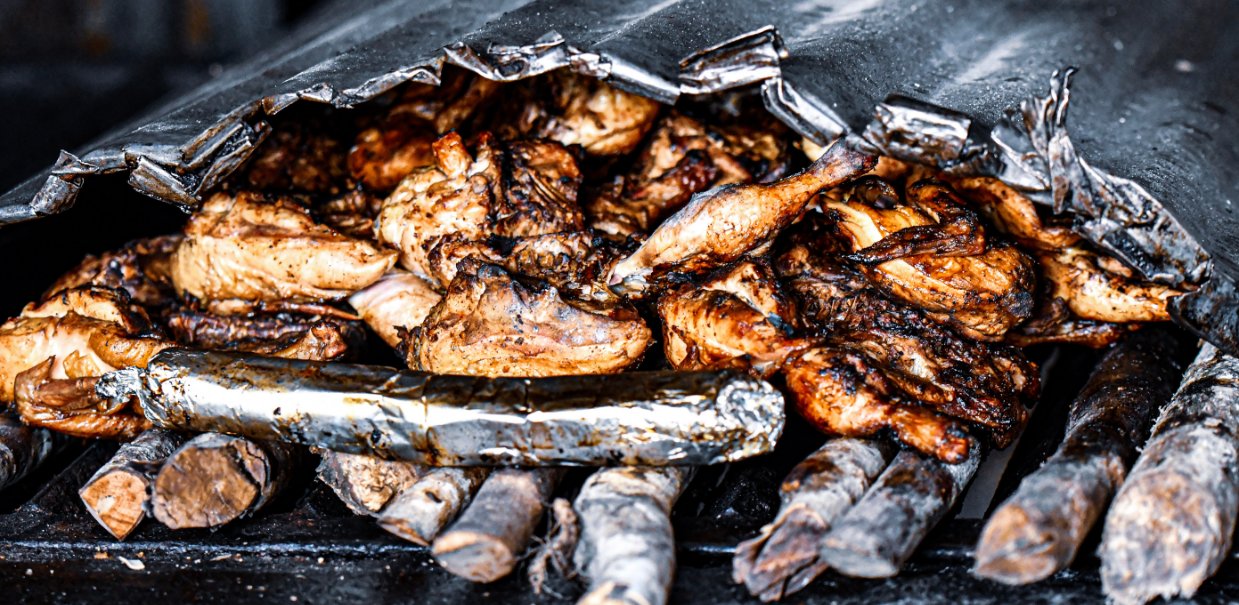
Two hundred years ago our ancestors survived on what came out of a hidden pit in the bush. Today the burn of pimento wood and the smell of seasoning searing into meat reaches you around the corner before you see the pan, and a man in the street hands you something extraordinarily flavoured in a piece of tin foil with a slice of hard dough bread on the side.
So the question is simply this. Do we go on treating jerk as ordinary, or do we claim it out loud, the way Marseille claimed a soup, and say what the rest of the world has already worked out. That jerk is one of the great culinary traditions on earth, and it is ours.
Written by Gina Tulloch-Adams, Publisher.
Home Sweet Jamaica's Publisher serves as Cultural Advisor to the Jamaica Jerk Championship. This article reflects her own view of why the tradition matters.